

Senior Spotlight: Isabel Bernhard
What is your thesis about and what are your main findings?
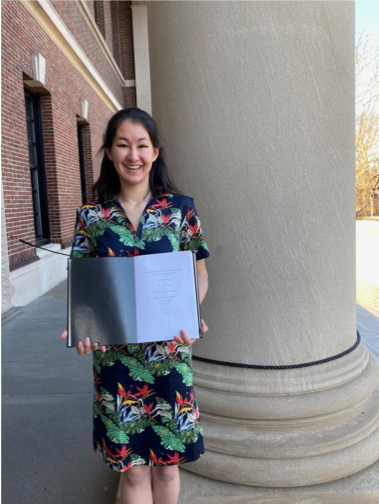
I wrote a qualitative political science thesis about democratic consolidation in Brazil and Argentina in the 1980s and 1990s. By studying each country’s national nuclear agency, I analyzed shifts in civil-military relations after their military dictatorships had ended.
I set out to answer how and why civilians consolidated control over military-managed nuclear programs during inchoate democratic years. I first created a new vocabulary to understand civilian control, then found that the sequence and difficulty of exerting control were caused by each country’s mode of democratic transition.
What made you choose that topic?
My thesis topic united three things: my family’s experience with authoritarianism, my coursework in Latin American Studies, and my internship experience in Argentina. I wanted to understand family stories of authoritarianism and democracy through an academic lens. I investigated this topic in Latin America because I deeply enjoyed the Latin America-centric courses in my focus field. I was also fortunate to intern in the municipal government of Buenos Aires the summer after my freshman year, alongside a cohort of Brazilian exchange students. This primed my interest in Argentina and Brazil in particular.
How was your field experience in Brazil (and elsewhere)?
I loved doing fieldwork in both Brazil and Argentina. I was fortunate to establish contact with archives and interviewees in advance, and thankfully everything went smoothly. My thesis trip was also my first-ever trip to Brazil, so I was trying to absorb as much as possible of the language, culture, and food everywhere I went.
In Rio, São Paulo, and Brasília, people were incredibly patient and kind as I navigated a tangle of logistics and documents. In several cases, interviewees and local professors very generously invited me into their homes for lunch or coffee, even on a weekend. In fact, during one meeting I spoke with someone while his family baked him a birthday cake in the background (for his birthday the next day). It was a privilege to learn in every context, and I really appreciate everyone who took the time to educate me.
Does winning the Kenneth Maxwell prize make you want to continue with Brazil and/or your field of study?
I’m incredibly grateful to receive the Maxwell Prize, and I never imagined that it would happen. Before I received the news, I was already excited to continue my studies of Latin American politics. Latin America and Brazil in particular have shown me how to be a better citizen and a more nuanced aspiring political scientist. The region historically has extensive civil society activism in social issues, and my own research highlights how a small number of committed individuals could strengthen fragile democracies. By learning from the example of everyday Brazilians, I hope to be a more engaged advocate at home for American social and political issues. Additionally, Latin American politics often provide much-needed nuances for political science theories. In studying Latin America, I hope to do my part to question and modify the generalizations in our discipline, so that political science is increasingly reflective of and accessible to people everywhere.
What do you think about virtual commencement?
I think virtual commencement made sense given the unprecedented health crisis we’re living in. I respect our country’s medical professionals and I want to protect family, neighbors, and friends. At the same time, I’m very much looking forward to reuniting with friends, classmates, and faculty on campus for a future in-person celebration. Everyone says it’s the people who make college special, and that rings truer than ever now that we’re all dispersed.
What are your post-graduation plans, and do they include Brazil?
Pandemic permitting, this fall I’ll be a master’s student in Latin American Studies at Oxford. In this and future endeavors, I’d love to continue learning about Brazil! I know I’ve barely scratched the surface of the country’s complexity—as someone once quoted to me, “o Brasil não é para principiantes”. I would be lucky to return.
Interview conducted by Kathleen Barrow, Brazil Office Fellow