Oases of Mezcal: A Oaxacan Community in Conversation with Harvard

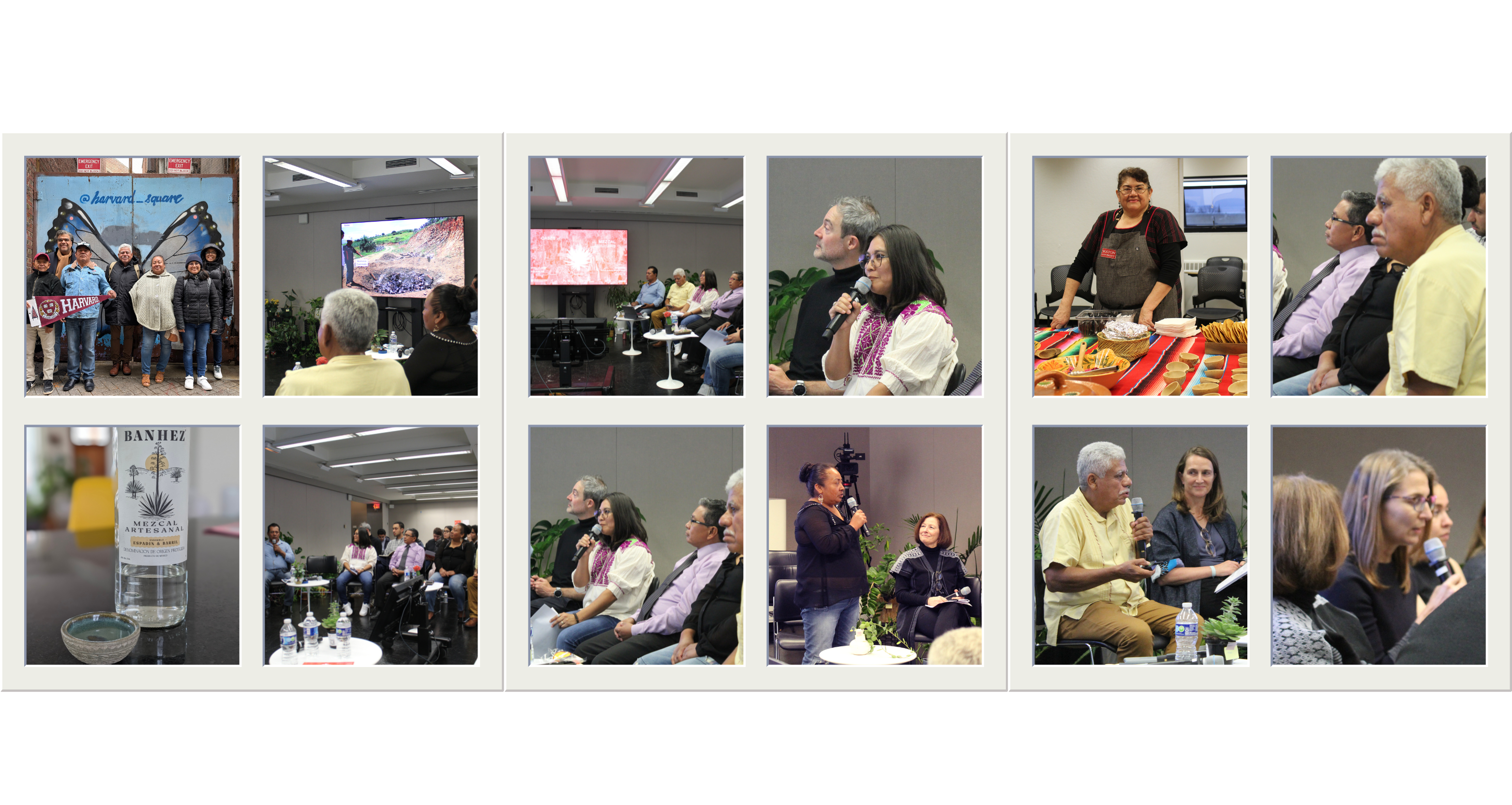
On April 11, 2025, the David Rockefeller Center for Latin American Studies (DRCLAS), in collaboration with the Harvard Graduate School of Design (GSD), Latin GSD, and the Harvard University Mexican Association of Students (HUMAS), hosted Oases of Mezcal, an afternoon of dialogue. The event was made possible by a DRCLAS Faculty Grant.
The gathering brought together Harvard students and faculty with community leaders, mezcal producers, and educators from Agua del Espino, a small town in Oaxaca’s Central Valleys. As global demand for mezcal grows, the community faces a critical decision: how to harness economic opportunity without sacrificing its environment, traditions, or cultural heritage.
The initiative builds on a project led by Pablo Pérez-Ramos, Associate Professor of Landscape Architecture at the Harvard Graduate School of Design, and funded by the DRCLAS Mexico Innovation Fund, in partnership with organizations such as Rethink Foundation, Enlace Fundación, and the Instituto de la Naturaleza y la Sociedad de Oaxaca (INSO). Working closely with Agua del Espino, the project has piloted strategies such as reforestation, water harvesting, regenerative agriculture, and circular resource use, while also creating space for direct exchange between community members and academics. Together, these efforts aim to establish regenerative “oases” that respond to the twin challenges of climate change and resource scarcity.
“Rather than a lecture, we wanted to create a space for dialogue—non-hierarchical and informal—where cultural traditions are recognized as essential to any meaningful community change,” explained Pérez-Ramos.
The afternoon unfolded in three conversations. The first, moderated by sustainability consultant Alberto Kritzler, explored how mezcal production can inspire socially responsible entrepreneurship. Memo Chávez, co-founder of Bruxo Mezcal and the Rethink Foundation, described how his ties to Agua del Espino gave rise to reforestation programs, community nurseries, and adobe construction that repurposes mezcal byproducts.
Tirmo Zorroza, president of the local comisariado ejidal, shared how rainwater harvesting basins and collective reforestation efforts have begun to tackle decades of water scarcity and deforestation. For Natalia Lázaro, a Mixe primary school educator and current principal of the Escuela Primaria Independencia, these efforts have also become a tool for environmental education, as children and families cultivate native plants and agave in a school nursery. Complementing this, community leader Eva Rodríguez recounted how women are taking the lead in turning mezcal waste into adobe bricks, reviving traditional methods while promoting circular economies.
The second panel shifted the focus from production to planning. Diane Davis, Charles Dyer Norton Professor of Regional Planning and Urbanism at the Harvard Graduate School of Design and co-Chair of DRCLAS Mexico’s Studies Committee, urged the need for a “third path” that reconciles heritage with innovation and equity. Architect Elisa Silva, GSD ‘02 and founder of Enlace Arquitectura and the Enlace Foundation shared how she and local leader Elias García walked the land with community members, mapping oral traditions and land use as a foundation for collective planning.
In the third panel, moderated by Amy Whitesides, an expert in resilience and adaptation, Pérez-Ramos discussed in detail some of the specific reforestation, water harvesting, and regenerative agriculture initiatives introduced in Agua del Espino. Biologist Francisco Roldán from the Universidad Nacional Autónoma de México (UNAM), expanded on this work, presenting a community-led land use study that identified zones for conservation, restoration, and production, integrating ecological, social, and cultural knowledge into long-term territorial strategies.
The three panels also involved the participation of GSD students Abraham Haim Majluf Rizo, Michelle Segura, and Miriam Hernández Medina, who contributed, with their perspectives, to a reciprocal learning experience between Harvard faculty, students, and members of Agua del Espino.
What emerged across all three panels was a story not only of challenges but of transformation. From planting over 10,000 trees and producing 1,700 adobe bricks to drafting community-driven land-use plans, this project has shown how academic research, and local knowledge can come together to spark regenerative change.
Oases of Mezcal was more than an event; it was a shared commitment to environmental stewardship, cultural preservation, and inclusive development. By reinforcing connections between Harvard and Latin America, DRCLAS helps drive collaborative initiatives focused on long-term solutions to the region's challenges.