Heliana Angotti-Salgueiro and the Growth of a Latin American Urban Studies Network

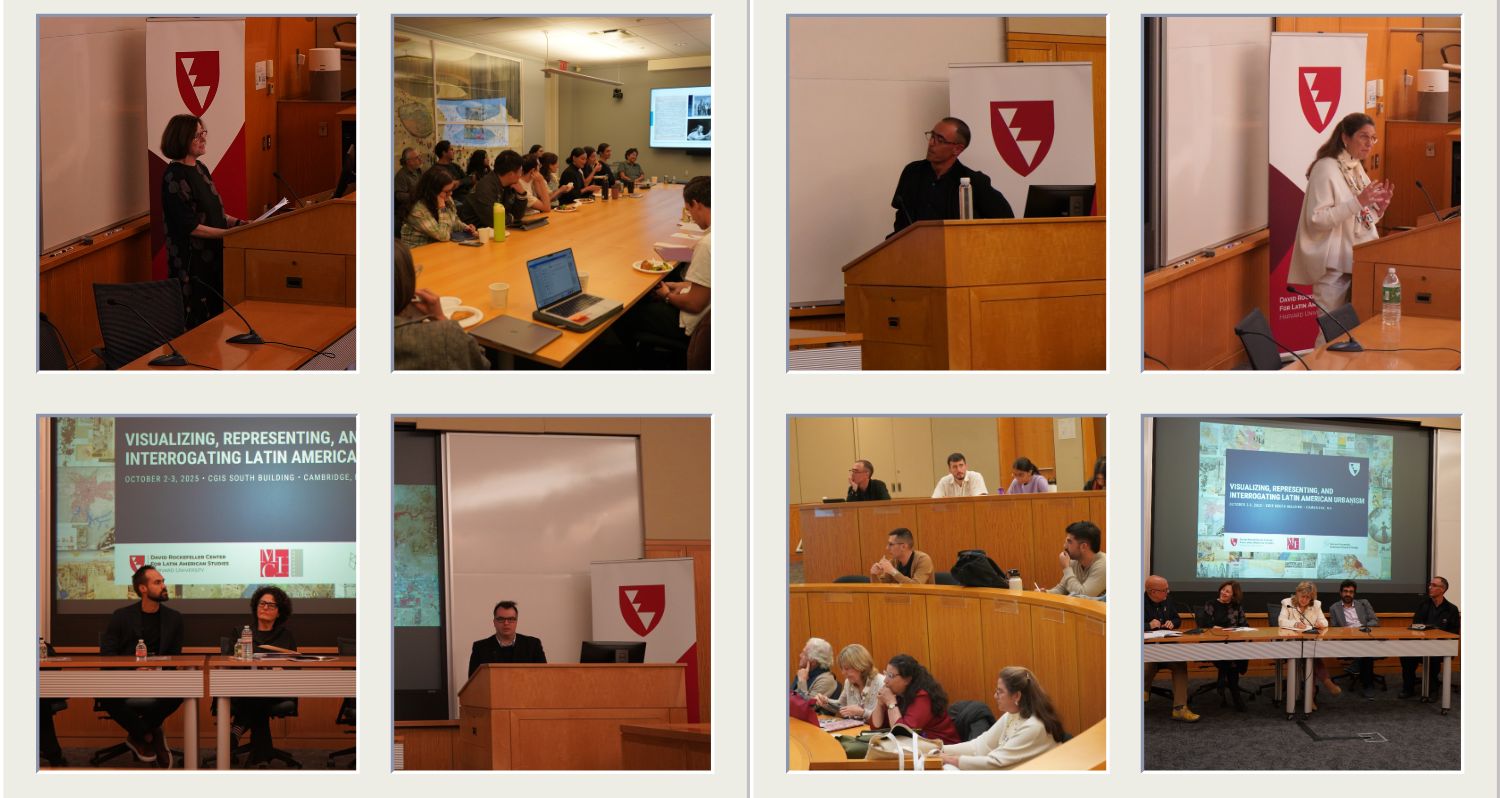
On October 2 and 3, 2025, the David Rockefeller Center for Latin American Studies (DRCLAS) at Harvard University co-hosted the colloquium “Visualizing, Representing, and Interrogating Latin American Urbanism: Buenos Aires, São Paulo, and Mexico City.”
Organized with support from the Mahindra Humanities Center and the Harvard Graduate School of Design—and funded through a DRCLAS Faculty Grant to Diane E. Davis, Professor at the Graduate School of Design and Co-Chair of the DRCLAS Mexico Studies Program—the two-day event brought together scholars of urbanism, architecture, history, and design from Latin America and the United States. Participants examined how digital tools and visual media are transforming the study of cities and expanding the possibilities of urban research.
Among the co-organizers and speakers was Heliana Angotti-Salgueiro, research associate at the University of São Paulo and former Peggy Rockefeller Visiting Scholar (2021–22) at DRCLAS. Speaking from Paris, she reflected on her journey from Visiting Scholar to co-organizer, describing the colloquium as “the result of connections that grew little by little.” Her time at DRCLAS, she said, “was essential to open those doors.”
A Bridge Between Research and Urban Visuality

Angotti-Salgueiro first came to Harvard in 2018 to study visual representation and urban culture. In 2021, she returned as a DRCLAS Visiting Scholar with a project on Luiz de Anhaia Mello, a key figure in São Paulo’s early twentieth-century urbanism. Working during the pandemic led her to experiment with new digital approaches to studying and visualizing the city—an interest sparked by Professor Eve Blau’s Urban Intermedia project at Harvard, which uses visual and digital tools to tell urban histories through images, archives, and narratives.
“My experience at Harvard was transformative,” she recalled. “Joining Eve Blau’s seminar at the Graduate School of Design opened my eyes to the potential of digital tools. I learned to think about the city not only as a physical or historical object but also as a network of images, archives, and representations in constant dialogue.”
A Growing Latin American Network
After returning to Brazil, Angotti-Salgueiro began collaborating with colleagues from Brazil, Argentina, and Mexico to build an interdisciplinary network that connects digital humanities, urban studies, and visual media. “Urban research today requires collaboration between architects, historians, designers, and artists,” she explained. “Digital humanities allow us to look at the city from new perspectives and create knowledge collectively.”
This collaboration has already led to two international colloquia: the first, held in São Paulo last May with support from the DRCLAS Brazil Office, FAPESP and USP; and the second event, on October 2 and 3 at Harvard. Both have strengthened ties between researchers in Latin America and the United States while highlighting contemporary challenges in the region’s urban landscapes.
The Harvard colloquium explored how visual experimentation and digital methods can generate new ways of understanding cities and environments, producing insights that extend beyond traditional academic narratives.
Angotti-Salgueiro is now working on a book about the intellectual history of urbanism and continues to expand this network through new projects and collaborations. “DRCLAS was the starting point of a process of personal and academic growth,” she concluded. “It taught me that studying the city is, in the end, a way of understanding how we think, imagine, and live in the world.”