

Experts and Chilean Professionals Convened at Harvard to Deliberate on the Challenges and Strategies Essential for Advancing Mental Health in Chile
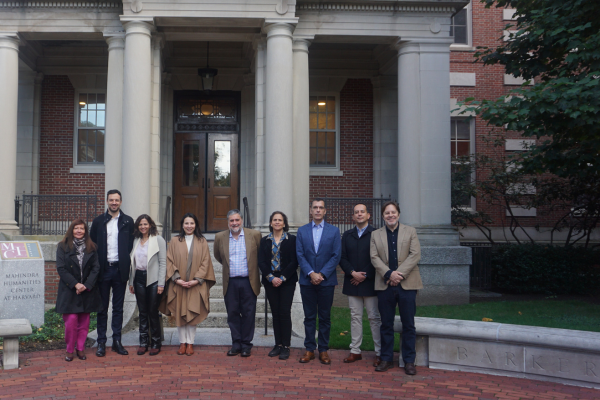
Marking a groundbreaking collaborative venture in Cambridge, faculty from Harvard joined forces with leaders from Chile's business sector, mental health specialists, and Chilean mayors to strategize on confronting the intricacies of mental health disorders. Their focus was on enhancing preventative measures in Chile during a workshop held on October 10th at Harvard University, as part of Harvard Worldwide week.
Employing preventive social technologies, this collaborative initiative united academic, and private sectors with municipal social leaders, focusing on bridging significant public mental healthcare gaps in Chile. Emphasis has been placed on women and children in two of Chile's most populated districts: Maipú and Peñalolén.
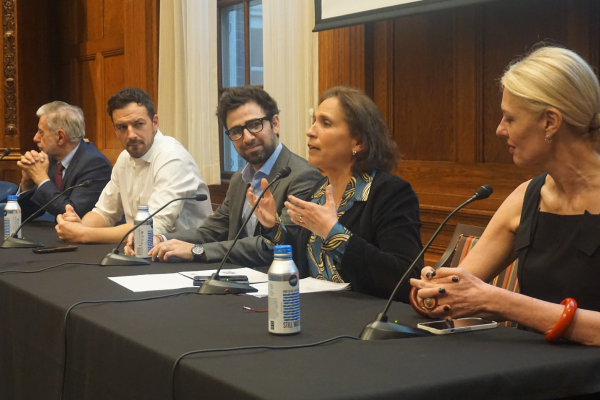
In this photo from left to right, Harvard professor, Fawwaz Habbal, Mayor of Maipú, Tomás Vodanovic, Benjamin Villa, Master’s in Design Engineering, Harvard University, and co-instructor with Professor Habbal, Mayor of Peñalolén, Carolina Leitao, ALI Senior Fellow, Claudia Bobadilla.
The workshop, titled "Collaborative Systems for Solving Complex Social Challenges: Preventing Mental Illness in Chile," presented current challenges, as well as programs and actions that are being implemented.
It was part of The High Impact Coalition Initiative to Improve Mental Health in Chile, spearheaded by ALI Senior Fellow Claudia Bobadilla, and Harvard professors Fawwaz Habbal and Doris Sommer.
The program aims to forestall further deterioration in mental health, including the prevention of suicide, initially in the municipality of Maipú, and subsequently in Peñalolén. Broadly, this initiative seeks to foster the development of effective mental health policies and programs that cater to the needs of vulnerable populations in Chile, especially in the post-pandemic era.
Professor Fawwaz Habbal emphasized that complex issues such as isolation and suicide necessitate a societal collective approach, with leaders assuming crucial roles. Tomás Vodanovic, the mayor of Maipú, underscored the necessity for augmented private-public collaboration in mental health prevention, particularly in the aftermath of the pandemic.
Mayor Carolina Leitao of Peñalolén noted the urgency of tackling mental health, supported by data from her district, which showed a 55% increase in mental health care for men and a staggering 75% rise for women between 2014 and 2022. Business leaders Roberto de Andraca, Board Director of CAP Group Company; Jorge Carey, President of CNN Chile; and Susana Torres, President of the Board of the Chilean-Swiss Chamber of Commerce, participated in a panel discussion aimed at bringing together diverse companies with a shared goal: crafting sustainable, innovative solutions to bolster mental health in the Maipú and Peñalolén communities. Speakers at the workshop implored all participants to join forces in a collective effort to enhance mental health indicators in Chile.
Related news coverage: "Harvard reconoce al programa Mente Sana de CNN Chile"- CNN Chile